Connection Corner
From Everyday Encounters to Stronger Communities - October 2026
Welcome to the October edition of Connection Corner! Since our August roundup, I’ve shared a number of reflections on how we build relationships, strengthen communities, and how we can intentionally create more opportunities for connection.
This month, I’m bringing together some of those conversations, along with personal stories, research, and examples from SCI’s work. I hope you’ll find some ideas worth explring, and I’d love to hear your thoughts on these topics!
Rebuilding Social Capital
Robert Putnam’s Bowling Alone helped inspire me to launch SCI more than two decades ago. So I particularly enjoyed hearing Putnam in conversation with former U.S. Surgeon General Vivek Murthy on the Staying Human podcast. Both have had a major influence on how I think about social connection.
Drawing on lessons from the Progressive Era, Putnam offered three recommendations for rebuilding community: Go Local, Go Young, and Go Moral. He emphasizes that we need to start with local initiatives, recognize young people’s power to create change, and embrace values that move us from an “I” orientation toward a “we.” These ideas definitely align with our work developing Social Capital Cultivators at SCI.
Read my LinkedIn reflections and watch a clip from my Harvard reunion talk,
In this LinkedIn post, I elaborate on the Putnam / Murthy conversation, and share a clip from my Harvard reunion talk about the inspiration to start SCI. I also explored practical community building approaches in my article, Five Ways to Build Bridging Social Capital.
Creating Opportunities for Connection
Bringing people together is an important start, but it doesn’t automatically lead to meaningful relationships. We need to be intentional about creating opportunities for people to develop authentic connections.
In a recent Connection Corner post, I share examples ranging from network bingo at community concerts to how we encourage young people from different Boston area communities to build relationships. One example of this effort succeeding was Soley’s multicultural celebration at a Boston park this summer, where young leaders created opportunities to share cultures and build relationships.
The Designing for Belonging summit at UMass Boston brought the connection conversation to a systems level. Beyond individual programs and events, how can we design our neighborhoods, transportation systems, and public spaces to make connection easier?
I was also struck by Robert Lewis Jr.’s reflections on Boston coming together around the World Cup. His challenge was to sustain that spirit of unity beyond the excitement of a major event. Building a more connected city takes ongoing commitment and intentionality.
Getting to Know Your Neighbors (and a Coyote!)
Sometimes it takes an unexpected encounter to make a connection. In my case, it was spotting a coyote carrying a rabbit through the neighborhood!
That unusual sighting finally prompted me to introduce myself to a neighbor I’d been exchanging waves with for months.
The experience reminded me of research showing that relatively few Americans know most of their neighbors. It also brought to mind psychologist Nicholas Epley’s findings that we tend to underestimate how positively others will respond when we initiate conversations with a stranger.
In this Connection Corner video, I share the story and some thoughts about why we should make the effort to get to know the people around us. No coyote required!
Listening First to Lead and Connect
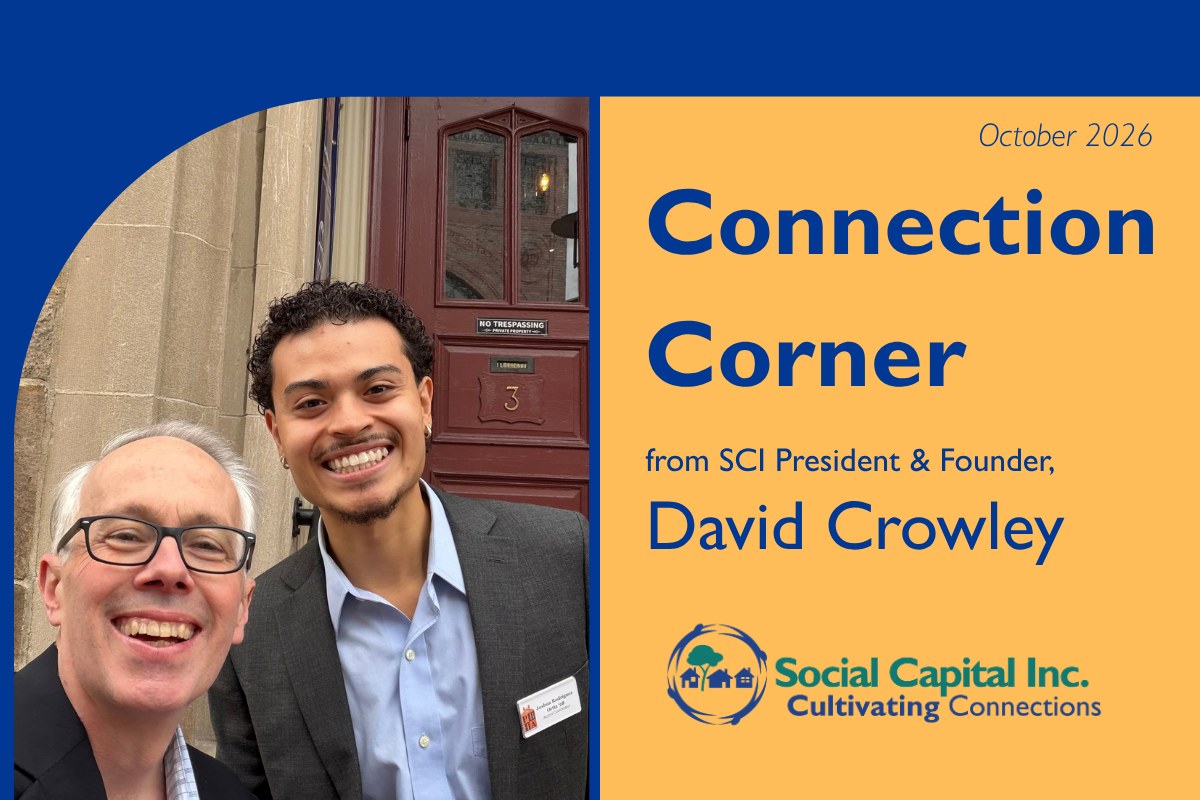
There were a lot of valuable insights at the Phillips Brooks House Robert Coles Call of Service Lecture in Cambridge recently. And it was especially meaningful to see former SCI LET intern Joshua Rodriguez Ortiz helping lead the event.
Dr. Murthy’s story that really stuck with me was about the beginning of his term as Surgeon General. He surprised his communications team by canceling all the big interviews they had set up, opting instead to travel around the country to listen to people’s experiences. Rather than arriving with all the answers, he started by learning from those he hoped to serve.
That approach reminded me of lessons from my former professor, Robert Coles, who emphasized the importance of listening to people and learning from their lived experiences.
Both Dr. Murthy and Dr. Coles remind us that whether we’re leading an organization, serving a community, or simply trying to build relationships, listening should be where we begin.
Explore my Connection Corner reflection on listening and recap of the Phillips Brooks House event. I also enjoyed reading Emily Weiner’s reflections on her takeaways from this event.
Remembering 9/11: Connection through Service
September 11 always brings me back to the AmeriCorps orientation we were running that morning in Boston. Amid the shock and uncertainty, I remember how our team at Generations Inc. made sure everyone felt they had support during that challenging time.
In my September 11 Connection Corner, I reflected on how crises can bring out our instinct to help others, and how service can create lasting relationships and a sense of shared purpose. Give it a read to learn about SCI’s very first community project, a Civic Participation Week to mark the first anniversary of the 9/11 attacks.
Baseball and Creating Space for Connection
During a summer visit to Cape Cod, playing baseball with my son Brendan got me thinking about the lessons I’ve learned from the sport. I shared three of them in a LinkedIn reflection: taking responsibility, showing up consistently, and making time for relationships.
That last point deserves particular attention. Over the years, baseball has connected me with my father, teammates, friends, and now my son. The game’s slower pace creates space for conversations, shared experiences, and relationships that develop over time.
For men in particular, friendships often grow through doing things alongside one another rather than getting together for conversation.
This connects with a suggestion from Dr. Robert Waldinger that I highlighted in August: One way to build new friendships is to spend time doing things you enjoy, alongside others who share those interests.
I also saw a parallel in a recent reflection by Jenn Hoos Rothberg, Executive Director of the Einhorn Collaborative. Writing about her daughter’s desire for more unstructured time, Jenn reminds us of the value of slowing down and leaving room for spontaneous connections. That’s part of what I love about baseball. The game gives us time to enjoy being together, with conversations and connections unfolding naturally.
Explore Further
- Roger Wong’s reflections on September 11 and service: How the tragedy inspired his commitment to serving others.
- SCI Youth Grant Pitch Contest summer projects: Including the Soley multicultural celebration.
- Nobody to Call report about friendships, community and purpose among men without college degrees.
- Staying Human Podcast Dr. Murthy talking with Robert Putnam
- Nick Eppley’s research on how talking to strangers can make us happier